

Inkless Agency
If you’ve found your way to this page, chances are you’ve already encountered AI today, whether you noticed or not. There’s no avoiding it: from search engines to spell check, it’s ingrained in the digital tools that most writers rely on. So, what’s a wordsmith to do? How can you use AI tools responsibly to support your writing without giving all the creative work to the robots?
As with most things in life, it’s all about adapting, evaluating, and learning how and when to use which tools.
Using AI the “Write” Way
As a writer, you have a lot of tools at your disposal. More than you might realize.
Of course, these tools can’t do all the work for you. A hammer can help you drive a nail into a wall, but you still need to swing it. And more importantly, you need to know how.
Whether you realize it or not, AI is probably already a part of your daily life. It’s responsible for the AI Overviews that show up in your Google search results. It recommends and curates your social media content based on your history, and it corrects your spelling when you're speeding through a sentence.
Of course, these are passive AI examples that you engage with unintentionally. When it comes to intentional AI uses, there are more than a few considerations for content-conscious writers.
A Matter of Ethics: Use Your Tools Responsibly
It’s a tale as old as time: people get excited about shiny new tech toys, but anyone who’s read enough of it can tell you that AI writing is pretty easy to spot. Even if you’re not publishing copy-and-pasted ChatGPT answers, AI content can still influence your work for better or worse.
First, let’s look at some of the ways AI can improve your writing. AI tools can help you:
Avoid plagiarism in your work
Catch spelling and grammar errors
Simplify your research process
Organize content efficiently
Brainstorm ideas
Overcome writer’s block
But of course, lean on AI a bit too much and you risk:
Getting content flagged and demoted
Deterring your audience with stale, robotic text
Gathering inaccurate information during your research
Farming: factory farming vs. backyard - you can tell the difference. Same with relying on techy tools too much.
AI for Writers: Understanding Your Digital Toolkit
ChatGPT, Grammarly, Gemini, and Google Search can all be useful parts of the writing process, but there’s more to them than meets the eye. Let’s go over a couple of examples of how they can be used and where they might trip you up.
ChatGPT: Help or Hallucination
ChatGPT is probably the most talked-about AI platform out there at the moment. As a writer, you probably don’t want to let the bots have all the fun, but that doesn’t mean they can’t help you out.
ChatGPT can be used to:
Summarize bulky, technical, lengthy blocks of text
Offer detailed breakdowns of complex topics
Craft outlines, content plans, and schedules
And more – if you can think of it, generative AI can probably help with it (or try to, anyway).
It can be a useful resource for many writers, but its responses should be taken with a healthy dose of skepticism. Current iterations of generative AI are prone to “hallucinations,” meaning there are times when they simply make up inaccurate answers or give false, misleading responses.
Be wary of answers that fall into extremes: both overly specific and broadly generalized responses are likely to be lacking valuable insight and nuance. Prompts involving math, numbers, and statistics are also risky.
Your best bet is to lean into ChatGPT’s strong points. The AI system is best at formulaic, categorized breakdowns of topics, providing comprehensive overviews for subjects you might not be familiar with. It can also be used to simplify complex language in a research paper or medical text, for example.
The more information you give it to work with, the less likely it is to hallucinate an answer, and the less likely you are to write something misleading, or flat out wrong.
Google Search AI: Avoiding the Noise
Whether you’re writing about a familiar topic or tackling some new subject matter, you’ll probably find yourself knee-deep in research now and again. It’s the hidden work of writing that takes more than a little practice.
Google’s not the search engine it used to be, but it’s still a name synonymous with internet inquiries. So you open your browser to look something up, and—lo and behold—the answers are AI-generated.
You might be familiar with Google’s AI Overview. It takes the form of a text box at the top of the search results page. Here’s an example of AI answers for a simple Google search:
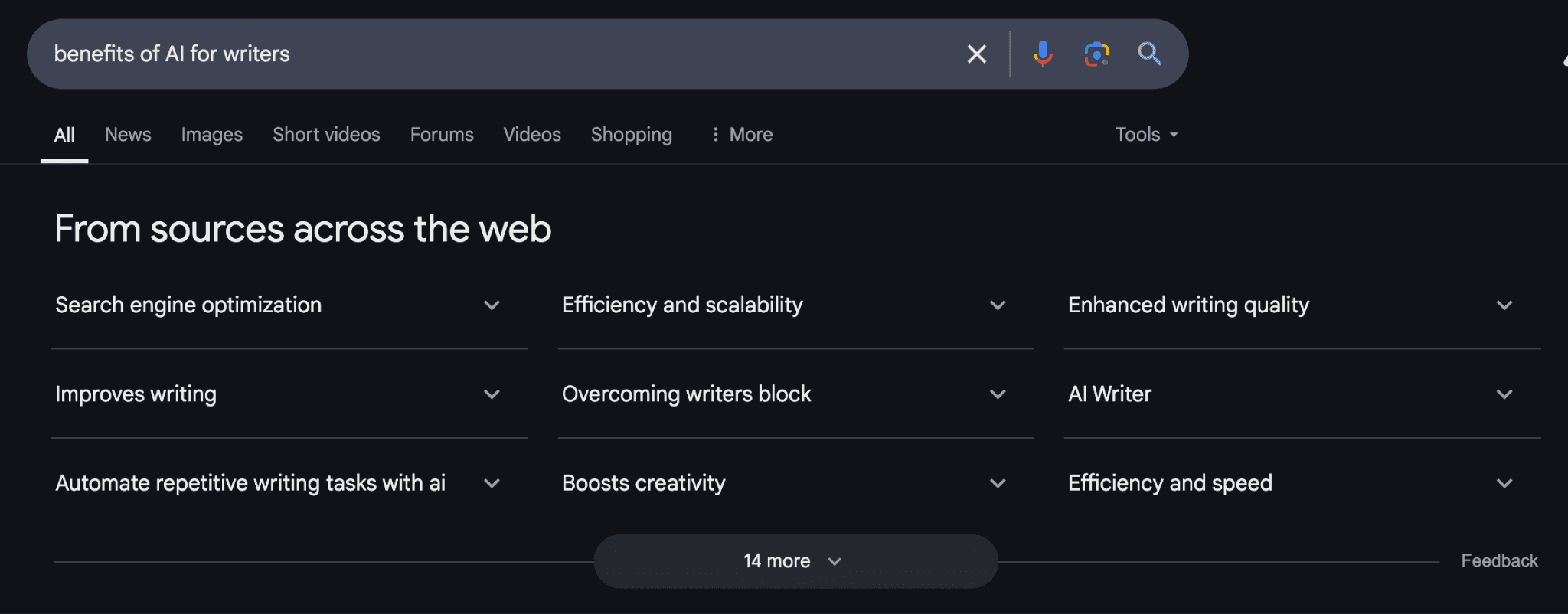
These are a few quick items that Google’s AI has compiled from various sources it deems credible. At a glance, it provides a passable overview of the topic, maybe even bringing our attention to some details or ideas we hadn’t considered before.
When we look at all the AI-driven answers, however, we see that some of them are redundant and repetitive. A couple don’t really make sense.
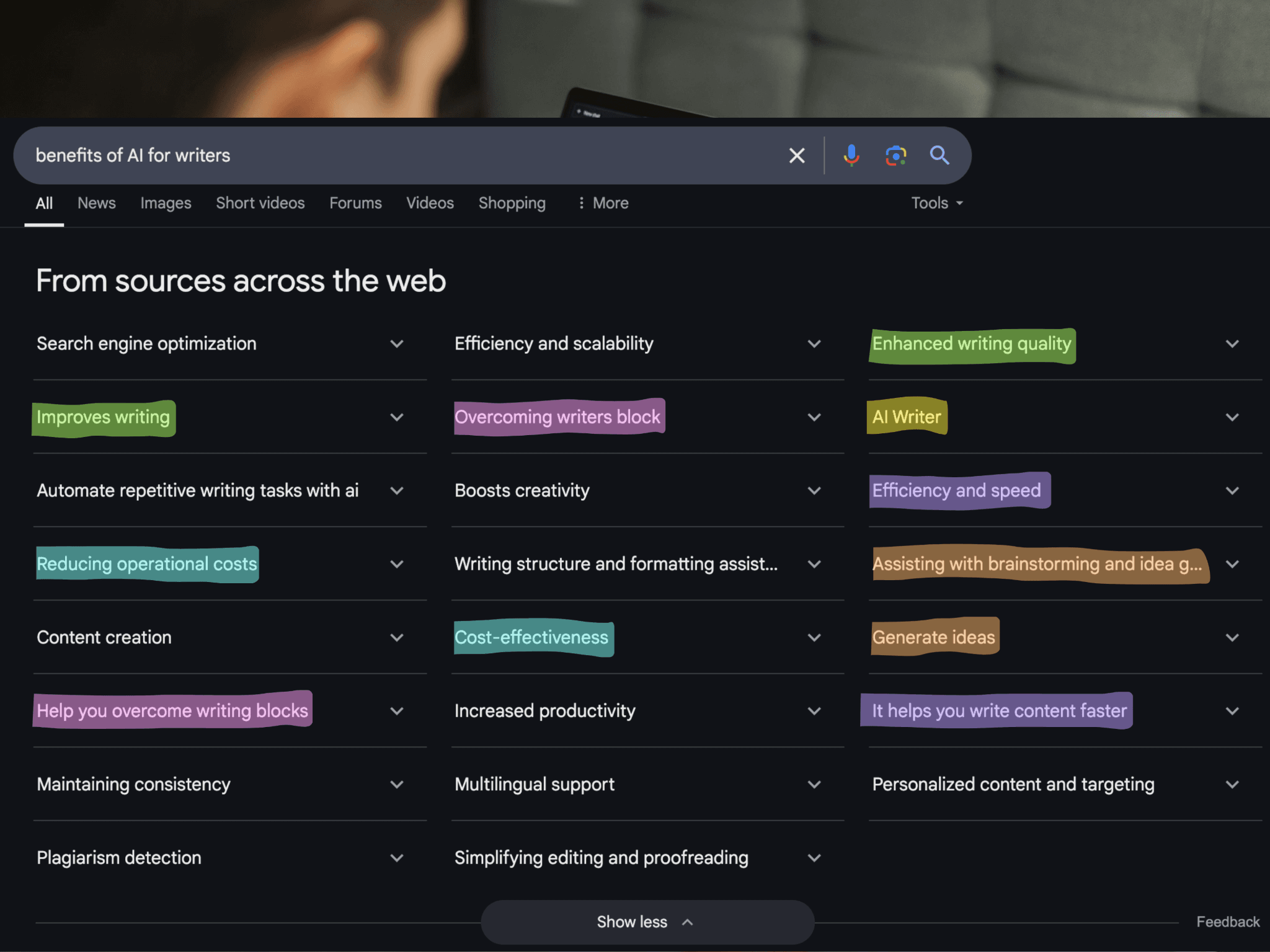
Caption: At first glance, it may look like a long list of answers, but upon closer inspection, we can see that many of these are redundant, repetitive, or incomplete.
One of the answers is simply “AI Writer,” which isn’t a benefit—it’s a tool. Many of the other answers are redundant—paraphrases of other answers that the AI doesn’t realize mean the same thing.
This is a low-stakes example, but the point remains: always take generated answers with a grain of salt. Treat AI like an intelligent friend who is prone to stretching the truth. They might be a great source of answers and ideas, but it’s important to approach their work with a critical eye.
Let’s drive this point home with one more example of how AI Overviews can skew your research:

For someone researching running gear, this AI overview isn’t a bad place to start. The images are a tad misleading, but even non-runners could probably guess that denim shorts aren’t the best marathon attire. And that’s not a picture of anti-chafing cream: it’s a headlamp. Common sense can easily overcome these little mistakes.
But what if you’re looking into something more obscure? A hallucinatory answer can easily derail your research with spatterings of misinformed search results and haphazard answers. God forbid someone thinks a sports bra is the same as sunscreen.
So, how can you avoid micro-misinformation in your work? When using AI for research, always fall back on your best judgment. If something feels off or sources don’t stack up, put on your detective cap. Double-check suspicious answers, evaluate the credibility of sources, and dig deeper when surface-level insights aren’t clear. Stay suspicious.
Spelling & Grammar
For writers, it might be the greatest thing since sliced bread. Digital spelling and grammar check tools save you valuable time reading and re-reading your work, looking for those stubborn out-of-place letters and clunky phrases. You don’t have time to hunt down every faulty noun-verb agreement.
A simple spell-check tool is one thing, but generative AI can be hiding there, too.
Grammarly
It’s one of the most popular AI tools for writers and non-writers alike. Grammarly not only checks your spelling and grammar, but it can also generate new text, suggest rewrites, and check for plagiarism and AI. Indeed, it can check for itself.
Tools like Grammarly are great for catching the little errors that writers might miss when we’re cranking out content, but there are times when you’re better off ignoring the suggestions. But why? If you have this magic grammar tool at your disposal, why wouldn’t you heed its syntactical warnings?
There are two main reasons: to preserve your authentic voice, and to avoid getting your content flagged for AI.
Preserving Your Voice: When to Ignore AI Suggestions
If you’ve used Grammarly, you know that it does much more than check your spelling and grammar. It can be used to generate, reorder, and rewrite sentences, putting your work square in the crosshairs of AI checking software.
A generated or rephrased sentence here and there won’t raise the alarm, but let the bots do too much of the writing, and your content will stick out like a bland and boring sore thumb.
We don’t always communicate in perfect, grammatically correct sentences—language just doesn’t work that way.
Organic writing is sprinkled with sentence fragments, idioms, exclamations, and quirky turns of phrase. It’s messy, colorful, chaotic, and fluid. Without these bits of linguistic flair, writing becomes textbook-like: stale, dry, and boring to read.
A tool like Grammarly might be able to tell you the best by-the-book way to structure a sentence. However, if you rely on the automated suggestions 100% of the time, your writing will lose its lovely, natural flavor.
As with other AI tools, take recommendations with a grain of salt. Check your spelling and evaluate your grammar, but look over any elevated suggestions with a critical eye.
Are they adding to your work, or stripping nuance from your words? Does that comma really need to go, or does it help the flow? Only you can decide.
Reason Over Robots: When AI Overcomplicates Things
There is a lot that AI can do, but almost every project or task needs some human touch.
It can be a great way to put content planning, scheduling, outlining, and drafting on autopilot, but there are times when it’s more trouble than it’s worth.
There’s no technological substitute for human experience and common sense. AI tools don’t “reason” the way human brains can.
To some extent, that’s not their job – they’re supposed to automate the mundane so that we humans can focus on strategic and critical thinking.
While it might seem like AI is the best way to optimize your work, there are plenty of ideas that work on paper but not in reality. If you find yourself confined by a formulaic outline or wading through a wordy draft, it might be time to kick the bots to the curb, at least for a little while.
When used responsibly, AI should free up more brain space for honing your craft. If you find it only complicates things, take a step back and reevaluate your use.
Final Thoughts: Embracing A Balanced Approach
As a writer, your voice is everything. Generative AI can deliver a factually and grammatically correct phrase, or a detailed explanation of a heady topic, but it lacks the nuance and charm of human speech.
Using AI responsibly is all about finding ways that AI can serve your work, not cheapen it.
At the end of the day, using AI is like wielding any other tool. Understand its limitations, know when to use it, and be wary of making things more complicated than they need to be.
There’s no replacement for human creativity and common sense—those are your most powerful tools, after all.
You have reached the end!
